
Separations
“My Eyes Fail from Weeping” – Lamentations 2:11

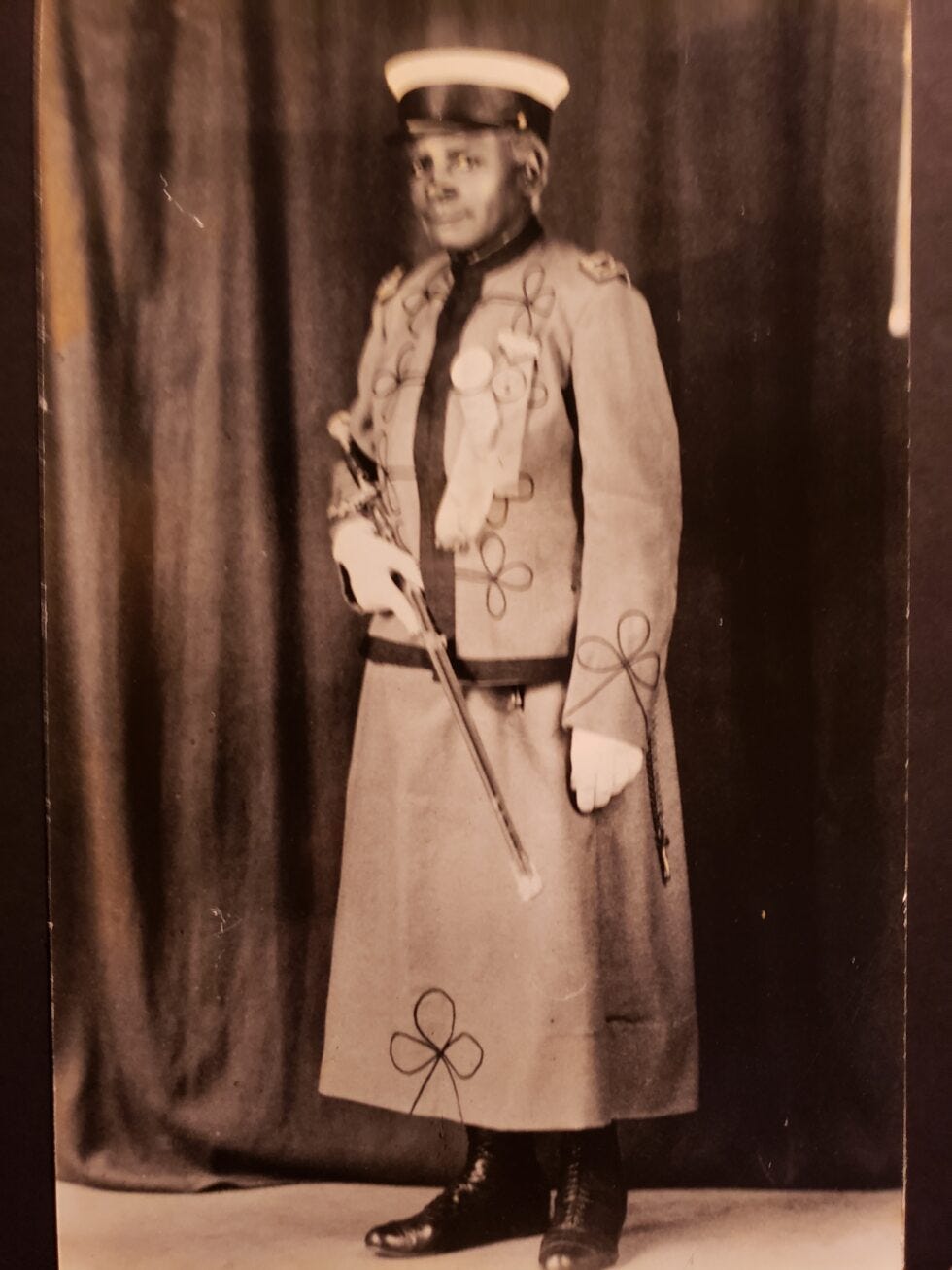
Diana Thompson was born at Farmington about 1818. Since her mother, Phillis was enslaved by John Speed, Diana was born into bondage. She was living on the plantation in 1841 when Abraham Lincoln visited there to stay with his best friend, Joshua Speed.
During her life, Diana gave birth to eleven children. It is a bit of a coincidence that Lucy Speed, John Speed’s wife, also gave birth to eleven children. Information about all of Lucy’s children is easily available. We know whether or not they grew to adulthood, to whom they were married, if they had children, and other details of their lives. There are no records, no documentation, telling us anything about Diana’s eleven children except for two: her daughter Dinnie and her son Henry.
Diana eventually became the “property” of Mary Speed, John’s oldest daughter. According to Dinnie, when Diana was still very young, Mary and her sister Eliza implored their father to let one of them have the girl so they could raise her and teach her the tasks she would need to perform the duties of a personal attendant. Of course, being an indulgent parent, John decided to let his daughters draw straws to determine who would have “possession” of Diana. Mary drew the lucky straw.
Diana probably spent much more time among Mary, Eliza, and Lucy than she did with her own family. This is one kind of separation that could be experienced by enslaved people. While Diana would have been physically close to her mother as they both worked in the house, she was nearly always under the supervision of Mary or a Speed family member. As she was growing up, it would have been the Speeds, not her mother, that most often provided for her needs, gave her permission to play, offered her special treats, and disciplined her.
Diana was likely treated with what the Speeds imagined to be affection, maybe “allowed” to sleep on a palette near Mary, and provided with better food and clothing than many of the enslaved community on the plantation. She also was constantly under the eye of the Speeds, some of whom seem to have been quick to respond to what they saw as a person’s deficiencies or failings. In an effort to encourage competence at her tasks, Diana would have quickly been corrected.
As young women, Mary and Eliza moved to the city of Louisville and Diana may have moved with them. This, of course, would have been another kind of separation. Diana would have been forced to move from the friends and family she had known since she was an infant. She would have been dependent upon Mary Speed to provide a pass for a visit to Farmington on an irregular basis just to spend time with the people she most loved.
Dinnie, Diana’s daughter, was born in 1857 while Mary Speed was living in Louisville. Late in her life Dinnie described her childhood on two different occasions to White women with whom she worked. Versions about how she, her brother Henry, and her mother claimed their freedom differ in some respects. In one version, she stated that Diana determined to escape after she was threatened with being sold at the notorious Arterburn Slave Pen. In a second interview, Dinnie more vehemently asserted that the motivation for her mother’s self-emancipation was to end the whippings and abuse being aimed at her children. Dinnie adds that several of her siblings had been sold at Arterburn’s. Whatever the exact reasons were behind Diana’s actions, she eventually escaped to Indiana with Dinnie and Henry. This was yet another type of separation that could be experienced by Black children in the antebellum South.
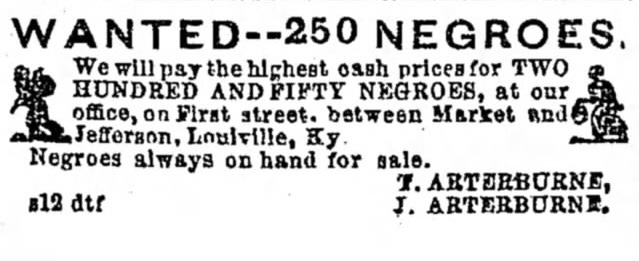
According to statistics from the National Park Service, between 1830 and 1860 nearly thirty percent of all enslaved children in the upper South were sold in the domestic slave trade. Dinnie’s statement more than hints that John Speed was a part of this inhumane practice of separation.
And, what of Dinnie’s father? Who was he? What do we know about him? Diana was listed in a post-Civil War census as the widow of Spencer Thompson indicating that she was recognized as his wife. Dinnie, too, had claimed the surname of Thompson. Spencer Thompson probably was Dinnie’s father but, like many enslaved children, Dinnie would have spent little time, if any at all, with him. Yet, another kind of separation inherent in the culture of the enslaved appears in the lives of Diana and Dinnie.
One other separation experienced between children and their families was common to both the White and Black populations around Louisville. There was a high probability that an infant born between 1810 and 1850 was not going to survive his or her first five years of life. In antebellum America, the overall mortality rate for all children ages one to five was estimated at around 40%. According to historian Nancy Disher Baird, “most antebellum mothers lost at least one child. . . .” For children born in bondage the mortality rate was over 50%.
There were a myriad of possible maladies and accidents that could bring about the death of an infant in those years before the Civil War. Diphtheria, cholera, and whooping cough could all have fatal consequences. Children suffered from asthma and other respiratory challenges. There were no vaccines for most childhood diseases, smallpox being one significant exception.
Accidents, of course, could never be ruled out. Children could wander behind horses or ponies and be kicked. During colder weather, fireplaces were particularly dangerous areas for children to be around, both White and enslaved. There are many stories of toddlers falling into a fire. Tales of children being burned by tipping over scalding water appear throughout the records. Minor cuts were prone to develop what we would recognize as staphylococcus infections in an era that was without antibiotics. Indeed, this is the most likely cause for the serious leg ailment suffered by John Smith Speed. The youngest of the six brothers, had been playing in water near the Speed home and developed an infection that threatened his life. The Speeds transported “Smith” (as they called him) to Lexington where a doctor with a reputation for successfully treating such maladies could tend to the seriously ill child. Smith beat the odds and survived.
In many ways, the Speed family was fortunate. John had lost at least two children and his first wife before he moved to Farmington. But, he and Lucy raised nine of their eleven children to adulthood. Thomas, their first born, died just a few weeks shy of his third birthday. Ann Pope Speed died at age seven. The cause of death for both children was never recorded.
No records are left of the children of the enslaved who died at Farmington. No graves mark their short time on earth. So far, no letters record the grief or sadness parents, siblings, family and friends felt for the death of those children. But like the prophet in Lamentations, the enslaved people at Farmington could cry, “My eyes fail from weeping.”
Until next time, my best to you and yours.
David
NOTES:
Information about the mortality rates for infants was obtained from “Slave Mortality” by Richard H. Steckel at Ohio State University. His article appeared in Social Science History and can be found at https://www.jstor.org/stable/1170958?searchText=Mortality+rates+for+antebellum+children&searchUri=%2Faction%2FdoBasicSearch%3FQuery%3DMortality%2Brates%2Bfor%2Bantebellum%2Bchildren%26so%3Drel&ab_segments=0%2Fbasic_search_gsv2%2Fcontrol&refreqid=fastly-default%3A06cb69e491e34c773fc4698cfd759025&seq=1
Steckel also published an article in Social Science History entitled “A Dreadful Childhood: The Excess Mortality of American Slaves.” In the article, Steckel makes the following statement:
Early childhood mortality rates peaked during the 1830s and were roughly twice as high during the I830s as they were before 1825 and after 1850. Mortality data for Massachusetts (Vinovskis, 1972) and indirect evidence for whites in the country as a whole (McClelland and Zeckhauser, 1982) suggest that conditions may have been approximately constant before I860. On the other hand, the average heights of white soldiers who fought during the Civil War declined by an inch between birth cohorts of 1820 and I860 (Margo and Steckel, 1983) and genealogies show a downward drift of five years in life expectation of whites at age 10 during the same time period (Fogel, 1986: 41). However, for the country as a whole infant and child mortality rates during the late antebellum period were considerably below those for slaves. This package of evidence on levels and trends suggests that slave children were relatively worse off earlier in the period, and therefore circumstances adverse to slaves during the 1820s and the I830s contributed to excess mortality.
Kimberly O’Toole’s “Enslaved Children in North Carolina” which appeared in Voces Novea: Chapman University Historical Review was also helpful in discovering information about childhood mortality rates in this era. The article can be accessed athttps://digitalcommons.chapman.edu/cgi/viewcontent.cgi?article=1072&context=vocesnovae
The article, “A ‘True Woman’s Sphere’: Motherhood in Late Antebellum Kentucky” appeared in The Filson Club History Quarterly in July, 1992. The collaborative effort by Nancy Disher Baird and Carol Crowe-Carraco was a wealth of information for this series of essays. It can be accessed at 66-3-4_A-True-Womans-Sphere-Motherhood-in-Late-Antebellum-Kentucky_Baird-Nancy-Disher-Carol-Crowe-Carraco.pdf
Nancy Disher Baird had an abbreviated version of this article published in the Western Kentucky University TopScholar publication in 2005. A copy of Baird’s article can be found at https://digitalcommons.wku.edu/cgi/viewcontent.cgi?article=1006&context=lib_pres
Jennie Cole and Jana Meyer published a helpful article about Dinnie Thompson in The Filson, a publication from the Filson Historical Society in Louisville. The article can be accessed at chrome-extension://efaidnbmnnnibpcajpcglclefindmkaj/https://filsonhistorical.org/wp-content/uploads/filson_20-3_for_muse.pdf
The National Parks Service has provided a succinct and informative article about the lives of enslaved children in antebellum America. It can be found at African American Children (U.S. National Park Service)
In 2021, The Courier Journal ran an article entitled See Inside the Farmington Historic Plantation in Louisville in which the lives of Diana and Dinnie Thompson are discussed. The article can bee accessed at See inside the Farmington Historic Plantation in Louisville
Information about the interviews of Dinnie Thompson came from two sources.
A transcribed version of Francis Ingram’s handwritten account of her interview with Dinnie Thompson can be found on line at Out of the Past (Women’s History) | FromThePage .
Farmington retains copies of the article in which Elizabeth Arterburn Wilson interviewed Dinnie Thompson.
Powerful and informative. Great work.